How the Queer Atlantic Business Hub is building connection, visibility, and support for queer entrepreneurs
When queer entrepreneurs build businesses, they’re often building more than a product, service, or brand. They are building a place to belong.
For many, entrepreneurship begins with a dream—the pull toward independence, flexibility, or to create community impact. For others, this is just one of the factors driving their decision to start their own business, or offer their own services. The others may have been more closely aligned with a workplace that never quite felt safe, an event where assumptions happened before introductions finished, or working as part of a system that did not provide equitable opportunity.
Until now, queer entrepreneurs in Atlantic Canada have worked without a formal regional organization designed specifically for them.
Now, the Queer Atlantic Business Hub is here to change that.
“The need was clear,” says Vanessa Burns, owner of Vanessa Burns Grant Consulting and current Queer Atlantic Business Hub board member. “For people to see themselves as part of this, whether their work is a side hobby, one of their many gigs in a gig economy, or a full-time thing, this will really open up access to opportunities and networking.”
Rooted in research
Launched in Moncton on March 13, the Queer Atlantic Business Hub is a new Atlantic-wide community created by and for 2SLGBTQIA+ entrepreneurs. Its mission is to help shape the future of queer business in Atlantic Canada, and it seeks to accomplish this through connecting queer entrepreneurs with one another, increasing visibility of queer-owned and queer-led businesses, and increasing access to education and supports.
The Hub was created as a response to a long-standing gap in the region’s business ecosystem. Its ideation began when the need was identified by the Canadian Queer Chamber of Commerce (CQCC)’s CEO and co-founder, Darrell Schuurman, as part of the work the organization does to remove barriers, build visibility, and ensure queer entrepreneurs have the connections and support they need to grow.
“We know that 2SLGBTQI+ entrepreneurs still face barriers, despite progress made,” Schuurman says. “So we set out to create change one connection at a time.”
This thinking informed the CQCC’s decision to select an Atlantic-based organization. In April 2025, the organization issued a request for proposal (RFP) to find a regional partner that could lead community engagement and help establish a dedicated regional queer business hub. The RFP was awarded to SeaChange CoLab, a Moncton organization led by owner and founder Corrie Melanson. It was one of nearly 30 bids, signalling many saw major potential in this idea.
For Melanson, the decision on how to begin was clear—work would start with listening. Her organization began working on the project in July 2025 and spent nine months mapping the landscape and listening to queer entrepreneurs across the region. This process included a survey that received more than 100 responses, nearly 30 in-depth interviews, focus groups, and provincial reports designed to better understand the lived experiences, barriers, and priorities of queer entrepreneurs across Atlantic Canada.
The research surfaced several themes from entrepreneurs like access to funding, mentorship, mental health supports, bilingual services, rural realities, and relationship-centred approaches. It also confirmed what many queer entrepreneurs already knew from experience—that existing business spaces are not always a good fit, and present barriers to queer team members.
These barriers can be overt, but are more often subtle, whether they appear as a registration form that does not ask the right questions, or a networking event where someone assumes a person has a certain partner, or a speaker lineup that doesn’t reflect the communities served.
“The data didn’t exist, so we had to go out, get the data and understand it for ourselves. And we found the research said, ‘queer entrepreneurs aren’t finding what they need in spaces that already exist.’ I can say—as a queer entrepreneur myself—that there are things that happen that make things feel uncomfortable, not inclusive,” says Melanson.
“It’s very subtle—a lot of spaces don’t know what they don’t know. With the Hub, it creates a safety and comfort which allows an entrepreneur to be their authentic self in a space where they don’t have to explain.”
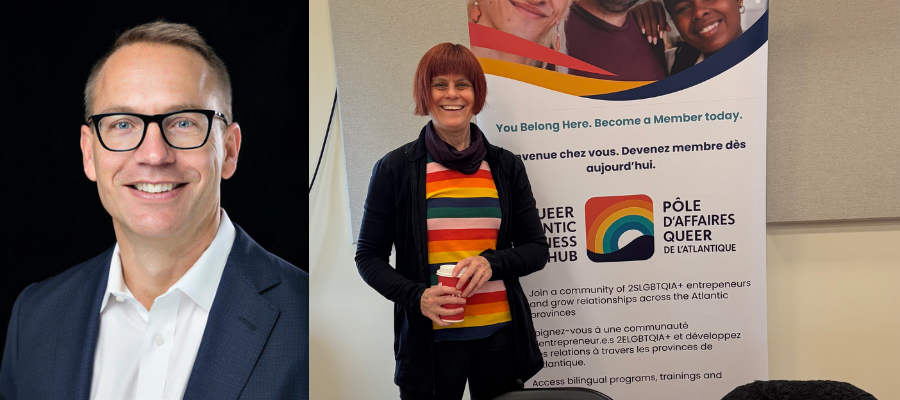
Darrell Schuurman (left) is CEO and co-founder of the Canadian Queer Chamber of Commerce (CQCC). Vanessa Burns (right) is owner of Vanessa Burns Grant Consulting and a current Queer Atlantic Business Hub board member.
An accessible, Atlantic-wide space
From the beginning, the Queer Atlantic Business Hub was designed to serve all four Atlantic provinces across diverse urban centres, rural communities, languages and cultures. Its mandate is to build a shared space across those differences, which meant it once again looked to the research it gathered to find intersectionalities.
This research showed several consistent needs across the region from information on grants, loans, and funding opportunities, to an online database of queer-owned businesses where members can find and support one another, to workshops and networking events, to peer learning and opportunities to discuss shared experiences.
With the hub’s foundation now in place, Melanson says SeaChange CoLab began an intentional recruitment effort to build a board reflecting communities the Hub serves. That meant regional representation, as well as intersectionality, youth representation, and inclusion of Indigenous, Black, newcomer, racialized, and trans community members. The first board orientation happened in March, and leadership is now fully handed over. As a board member herself, Burns says SeaChange CoLab has more than delivered on this work, and that the board is unlike any she has served on before.
“We have the most diverse board I’ve ever sat on,” she says. “It is entirely bilingual and committed to being bilingual, with lots of representation from Black, Indigenous, and trans communities. We reflect on who we’re serving and make sure that representation is there.”
The Hub arrives at a moment when queer entrepreneurs are already contributing to local economies, cultural life, innovation, and community resilience. What has been missing is infrastructure built specifically with them in mind, and which creates opportunities for networking and connection building.
These connections, in turn, create safety and comfort that has become even more important amid rising anti-queer and anti-trans sentiment, according to Melanson. They note there remain places across Atlantic Canada where entrepreneurs feel comfortable sharing that they are queer. For those business owners, having access to a queer-centred network offers a meaningful source of support, visibility, and connection.
“When you’re in a space where you don’t have to explain yourself over and over again, that matters,” says Melanson.
Building with intention
Another priority in building the Hub was ensuring access to it and its services. Burns says membership is designed with three levels to help make participation more affordable, and programming is offered bilingually, and in both virtual and hybrid formats whenever possible to reduce travel barriers.
“To be able to connect with other queer entrepreneurs, without travel, and to really connect with people who understand Atlantic realities, makes the Hub a great thing to be a member of,” Burns says.
Its launch in Moncton signaled the beginning of the work that is to come. The Hub has continued showing up in community, with its first community event that took place in Hantsport on May 27. Burns says the response from those who attended was very encouraging, and sparked awareness and conversations with potential partners and collaborators.
“In order for people to know who we are, they have to know we exist,” she says. “We want people to understand we are here to support, and collaboration is an important piece of that.”
For Melanson, connecting with queer business hubs across Canada reinforced an important lesson: no region needs to reinvent the wheel. She says that as it continues growing, the Hub will operate as a regional affiliate of CQCC, and connect into a shared system where queer chamber hubs across Canada share events, happenings, trainings, all in combination with Atlantic Canada-specific programming.
“The way it will eventually work is you become a member of your region or province, then get an affiliate membership for the national CQCC organization,” she says.
Schuurman says this direct link will allow for ongoing alignment around programming, advocacy, supplier diversity, certification, and community engagement, and a direct path ensuring Atlantic voices remain part of national conversations.
“We’re continuing to explore ways to strengthen these relationships through both digital and in-person touchpoints, with a focus on ensuring regional voices remain central to national conversations and initiatives,” he says.
The CQCC has recently undergone its own evolution, evolving in October 2025 from Canada’s 2SLGBTQI+ Chamber of Commerce to the Canadian Queer Chamber of Commerce. Schuurman says this shift, which happened alongside the launch of a new membership model called The FAM, was intentional.
“It reflects our commitment to better represent the full diversity of the queer business community, and to connect more meaningfully with entrepreneurs who may not have seen themselves reflected in traditional chamber structures and spaces,” he says.
An idea becomes reality
The Queer Atlantic Business Hub is still new, and its membership portal is opening. It has set a goal to welcome 100 founding members as it launches, grows, and continues shaping its direction. For Burns, the most exciting part right now is seeing what was just an idea become reality.
“Seeing a concept take off, from RFP to recent launch,” she says. “We’re very excited and keen to have this in the Atlantic provinces.”
Supports that members can now access include virtual workshops and learning sessions focused on starting, sustaining, and growing a business, as well as information on funding, collaboration, and business opportunities.
Burns says an even deeper value may be the ability to find one another, and reduce the isolation many queer entrepreneurs experience. This will happen through a mix of elements, from the Atlantic Queer Business Hub badge members can use on their websites and social platforms to signal their place in a growing regional network, to monthly virtual events that foster connection and peer support.
“Networking events, coming together and meeting with other queer entrepreneurs, discussing shared experiences with like-minded people—those opportunities to connect with each other and cross-share things make a big difference,” she says.
Allies also have a role to play. Schuurman says supporting queer-owned businesses both can and should go beyond symbolic gestures, whether by actively seeking out certified queer-owned businesses, embedding diverse suppliers into procurement processes, pursuing Rainbow Registered accreditation, and/or ensuring internal policies and practices are genuinely inclusive.
“Supporting queer-owned businesses is a smart economic strategy,” he says. “This is where inclusion and strategy intersect.”
At its heart, the Hub is about more than business support, according to Burns. It is about safety, visibility, access, community and even confidence. It’s about making sure queer entrepreneurs across Atlantic Canada do not have to build alone, and recognizing that when queer businesses grow strong, the entire region becomes stronger.
“That’s why, at the end of the day, the Hub was founded—to create a place where queer people feel supported and safe, where they can gather and feel others understand,” says Burns.
Join us on July 28 for “PATIO PERSPECTIVES: Closing Gaps with the Queer Atlantic Business Hub.”