Growth, equity, and the evolving electoral map
While the province’s decision to create a protected electoral riding for the Acadian community of Chéticamp represents a thoughtful approach to ensuring voices are heard and communities are represented based on their cultural identity, this change comes at a time when rapid population growth in urban areas like Halifax are raising important questions about the equity and balance of representation across a growing province.
What are electoral boundaries?
In Nova Scotia, electoral boundaries (or electoral districts) divide the province into geographic areas known as ridings, each of which elects a representative to the provincial legislature. These boundaries are periodically reviewed and adjusted to reflect changes in population, while also considering factors like community identity, geography, and cultural representation.
Individuals who wish to serve as elected officials (typically affiliated with political parties or running as independents) campaign within a riding to earn the support of voters. If they win, they become a Member of the Legislative Assembly (MLA), responsible for representing the interests of their constituents, contributing to debates, reviewing and voting on legislation, and helping shape provincial policy and decision-making.
Background
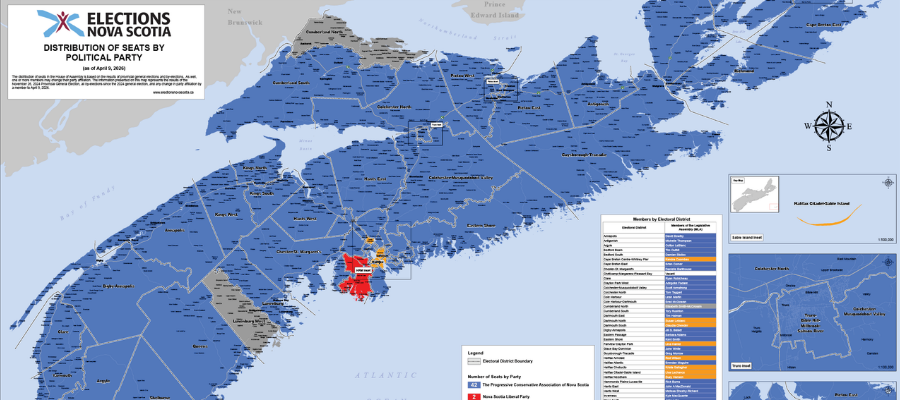
In February of 2026, the provincial government passed legislation to create a new electoral district in the community of Chéticamp in the county of Inverness in Cape Breton to improve the representation of Acadian Nova Scotians.
Under Nova Scotia’s House of Assembly Act, an electoral boundary review is required at least once every 10 years. In practice, this means the province typically establishes an independent Electoral Boundaries Commission once per decade to assess and recommend changes.
While the last full review took place in 2019, setting the next scheduled review for 2029, reviews can occur sooner if prompted by legal considerations, as was the case with the 2025 Chéticamp review.
Why does it matter?
Concerns were raised at Law Amendments about whether conducting a targeted review ahead of the scheduled 2029 timeline, focused solely on the Chéticamp riding, might reset the clock for the next full electoral boundary review, potentially delaying it until 2035 during a period of historic population growth.
Additional concerns are that it sets a precedent for one-off, legislated boundary changes and could delay broader representation reviews, affecting fast-growing regions like the Halifax Regional Municipality (HRM).
Has Nova Scotia conducted early boundary reviews before?
The clearest example before 2025 is the 2018 to 2019 electoral boundary review, which was conducted earlier than the strict ten-year cycle. That review followed a series of court challenges and the work of the Commission on Effective Representation in 2017 to 2018, which prompted the province to revisit boundaries sooner than expected.
More broadly, Nova Scotia’s history shows that while boundary reviews are normally done every ten years, exceptions have occurred when legal rulings intervene. The 2025 Chéticamp focused review fits this same pattern. It was triggered by a Supreme Court of Nova Scotia’s decision that found the previous boundaries failed to provide effective representation for Acadian Nova Scotians under the Charter.
What is different about 2025 is the scope. Previous early reviews, like the one leading into 2019, were province wide. The Chéticamp review is unusual because it is a targeted, single region intervention, rather than a full system-wide reassessment.
So, in essence, Nova Scotia has stepped outside the regular schedule before, but almost always due to court driven requirements and usually through broader reviews, not one-off adjustments focused on a single riding.
Recent population changes
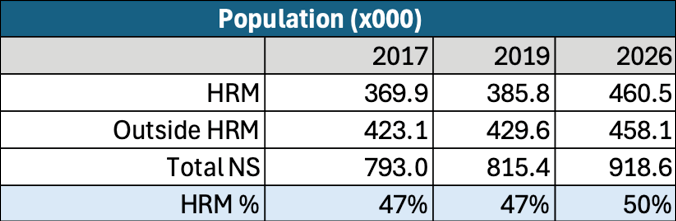
Since the last full electoral boundary review in 2019, Nova Scotia has experienced a period of significant population growth, with much of that increase concentrated in HRM. This shift has reshaped where people live, work, and access services, placing new pressures on how representation is distributed across the province.
Between 2019 and 2025, Nova Scotia’s population grew by 87,800 people, with 76% of that increase concentrated in the Halifax Regional Municipality. As a result, HRM’s share of the provincial population rose from 47% in 2019 to 50% by 2026.
Recent provincial electoral boundary changes
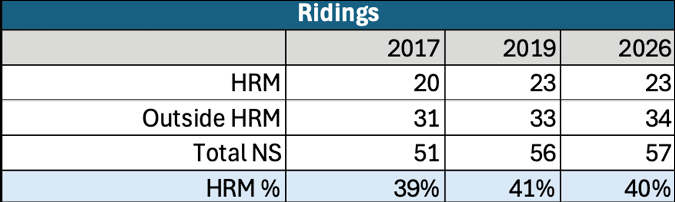
Before the 2019 review, 47% of the population in HRM was represented by 39% of MLAs. After the 2019 review, that same 47% was represented by 41% of MLAs. Following the 2026 changes, 50% of the population is now represented by 40% of MLAs.
Recent federal electoral boundary changes
Elections Canada conducted a review in 2022/23, driven by population growth identified in the 2021 census and the need to rebalance representation across the Nova Scotia. An independent commission reviewed where people are living and adjusted riding boundaries, so each one reflects a similar number of residents. While Nova Scotia kept its total of 11 federal seats, many ridings were reshaped and renamed to account for growth, particularly in and around Halifax.
Considerations for policy-makers going forward
Looking ahead, policymakers have several options in how they approach future electoral boundary reviews, ranging from maintaining the current timeline to adjusting it. One option is to wait until the regularly scheduled 2029 review, which would provide stability and aligns with the established review cycle. Another option would be to delay the next full review to 2035, which could reduce the frequency of boundary changes, but may also allow representation imbalances to deepen over a longer period and increase political pressure from fast-growing regions. A third approach could involve advancing the timing of a broader review, offering greater responsiveness to demographic changes but raising questions about consistency and system-wide equity.
Each of these paths carries trade-offs related to timing, fairness, and the principles guiding representation. As Nova Scotia continues to grow and evolve, the approach taken to electoral boundary reviews will play a key role in shaping how we balance governance throughout Nova Scotia.