
What federal defense spending means for Halifax and Nova Scotia’s economic outlook
This year’s federal budget has placed defence and security spending firmly among its priorities, committing an additional $82 billion over five years. For a province with deep military roots and a growing defence economy, the question is less about whether spending will rise and more about how the investment will land locally.
Across Atlantic Canada, organizations working at different points in the defence ecosystem share a consistent message: opportunity is real, but execution will determine the outcome.
Building momentum, sharpening priorities
For the Atlantic Canada Aerospace and Defence Association (ACADA), the current moment is defined by growing momentum across the region. “Across Atlantic Canada, we’re seeing a notable sense of optimism among ACADA members as federal attention on defence and security spending increases,” says Victoria Belbin, President and CEO of ACADA. “Many companies are preparing strategically, but the sector is also looking to the upcoming Defence Industrial Strategy for clarity on where Canada intends to focus its investments.”
That anticipation is tied closely to signals coming from Ottawa about how and where defence dollars will be deployed. “What we do know is that the federal government has signaled the importance of targeted regional investments aimed at expanding Canada’s industrial capacity,” says Belbin. “These investments have the potential to drive innovation, accelerate technology development, and strengthen supply chains across the country, including right here in Atlantic Canada.”

ACADA’s role has been to ensure companies are positioned to respond to shifting national priorities quickly and effectively. “As the landscape evolves, ACADA is working closely with government partners to ensure that our business community and broader innovation ecosystem have timely, actionable information,” says Belbin. “Our priority is to help companies understand where the opportunities are emerging so they can align their resources and continue to scale their capabilities in support of Canada’s defence and security objectives.”
Small and medium-sized enterprises account for the majority of ACADA’s membership, and according to Belbin, many are well positioned to respond to increased investment. “Many ACADA members are already active in global markets and are benefiting from rising international defence spending,” she says. “For SMEs with established defence platforms and capabilities, the current environment presents strong growth potential, both at home and abroad.”
Belbin points to several regional advantages that allow smaller firms to compete and scale. “SMEs in Atlantic Canada benefit from a distinct strategic advantage,” she says. “Our region’s geography, deep defence and ocean tech heritage, and strong network of supports, ranging from research institutions to innovation accelerators, are part of the culture.”
That culture is exemplified through Atlantic Canada’s involvement in NATO’s Defence Innovation Accelerator for the North Atlantic (DIANA), says Belbin. Halifax is home to the North American Office for NATO DIANA, with the accelerator located at COVE. Two other NATO DIANA test centers are based in Newfoundland and Labrador.
Being on the global stage is particularly impactful for local SMEs, adds Belbin. “This level of collaboration across the regional ecosystem is drawing growing international attention, positioning Atlantic Canada as a hub for defence and dual use innovation and giving SMEs expanded access to global networks and commercialization opportunities,” she says.
At the same time, the sector is growing. “We are also seeing interest from companies that are newer to the defence sector and now recognizing the scale of opportunity that defence can offer,” she says. “ACADA and our partners are working to finalize clear entry pathways to help these firms understand procurement requirements and build the capacity needed to compete effectively.”
Workforce availability, however, remains the most immediate constraint. “The region is already experiencing shortages in key trades, technical talent, and digital skill sets,” says Belbin. “Increased defence spending, while positive, will amplify this demand.”
Execution and efficiency in the economic picture
From a regional economic perspective, Patrick Brannon, Senior Researcher at the Atlantic Economic Council, says the scale of federal investment holds immense potential. “The growth in spending could be transformational, but execution and efficiency of the spending will be very important,” says Brannon.
Brannon outlines the scope of the federal commitment. “In the federal budget, it was announced that spending on defence in Canada will increase by $82 billion over five years,” he says. “About $20 billion will go to recruitment and retention. Those already in the military will be getting pay raises and recruitment will be ramped up over the next few years.”
Infrastructure and capability upgrades also feature prominently. “Nineteen billion dollars is for new and upgraded infrastructure, including upgrades to bases,” says Brannon. “Eighteen billion dollars is for enhanced capabilities including logistics, armoured vehicles, drones and other technology. This also includes funding to boost our presence in the Arctic.”
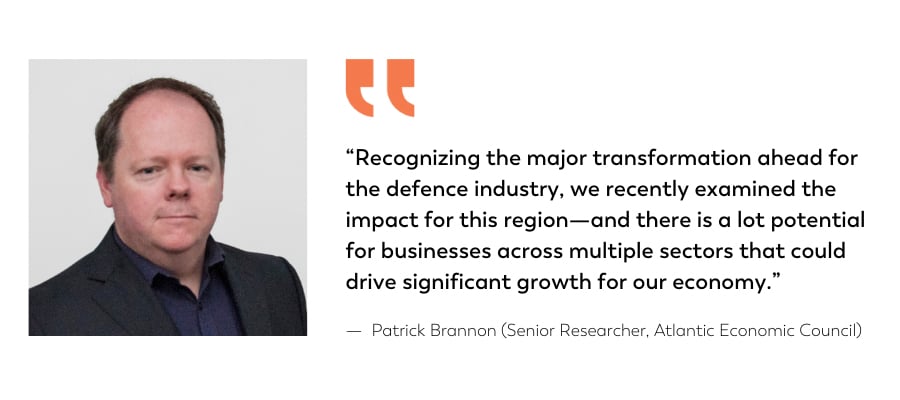
An additional $11 billion is earmarked for digital, cyber, and communications investments. “There are opportunities for Atlantic Canada in every one of these areas,” says Brannon. “Recognizing the major transformation ahead for the defence industry, we recently examined the impact for this region—and there is a lot potential for businesses across multiple sectors that could drive significant growth for our economy.”
That positioning is tied directly to employment concentration. “Department of National Defence employment per 1,000 workers in Canada is highest in Nova Scotia by a wide margin,” says Brannon. “The Halifax and Greenwood areas will especially benefit from increased wages and higher overall spending.”
Those points generate ripple effects across the broader economy. “New jobs will be created in the military, but supply chain opportunities will have a big impact,” says Brannon. He points to recent shipbuilding activity as a clear example. “The Arctic Offshore Patrol Ships being built at the Halifax Shipyard have created $5 billion of supply chain opportunities in Atlantic Canada, including $4.5 billion in Nova Scotia.”
That activity is expected to grow. “The larger second phase of River Class Destroyers is underway,” says Brannon. “This will see employment and supply chain activity grow.”
Supply chains and growth across sectors
Beyond shipbuilding, Brannon says defence investment touches a wide range of industries. “Atlantic Canada is poised to become a hub for defence innovation and manufacturing,” he says. “We have existing strengths in naval construction and repair, aircraft fabrication and maintenance, training services and sensor technologies.”
Other sectors stand to benefit as well. “Transport services will benefit from defence spending, including logistics and truck and marine transport,” says Brannon. “Professional services will grow including engineering, legal and accounting.”
Manufacturing and oceans-related industries are also positioned to see new demand. “Manufacturing will benefit from increased supply chain opportunities,” says Brannon. “Firms in the oceans sector including subsea activities could find new markets in defence.”
Technology and real estate are part of that picture. “The province’s tech sector could see growth in remote and sensor technologies, augmented and virtual reality and cybersecurity,” says Brannon. “The real estate sector will benefit, especially industrial, as new companies come into the region to support projects and existing companies expand.”
Defence in a shifting global landscape
Atlantic Canada’s defence role is evolving alongside global geopolitical pressures. “The region will have an opportunity to play a greater role in the maintenance of new submarines and aircraft that will be procured over the next two decades,” says Brannon.
International collaboration is also expanding. “The federal government is working hard to open up new opportunities for Canadian firms to support European defence projects,” he says. “Global spending on defence is growing at its fastest pace since the late 1980s.”
That growth is intersecting with capacity in the region. “Our research capabilities to support the defence industry are growing,” says Brannon, pointing to COVE, NATO DIANA, Defence Research and Development Canada, and Canada’s Ocean Supercluster.
Private-sector investment is following suit. “Several international firms like Lockheed Martin, Airbus, L3 Harris, General Dynamics and Thales are already active in the region,” says Brannon. “We expect those firms to expand and new firms to enter the region as activity picks up.”
Innovations in infrastructure and capacity building
For Michael Peters, Chief Executive Officer at Kluskap Suliewei, increased defence and infrastructure spending intersects with a long-term approach to capacity building. “With Kluskap Suliewei, the alternative asset division of our nation’s investment arm, we’re focused on building vertical integration,” says Peters.
That integration brings together security, construction, and health and safety in a way that reflects how projects operate in practice. “Defence and critical infrastructure projects are complex by nature,” says Peters. “They involve sensitive sites, strict regulatory requirements, and zero tolerance for failure.”
Rather than operating in silos, Peters says alignment is essential. “We believe this is what makes us attractive partners—we offer the full package,” he says. “Security teams understand how sites operate day-to-day and how risk evolves on the ground. Health and safety teams focus on training, compliance, and identifying issues early. Construction integrates those requirements into assets that must perform reliably in regulated environments.”
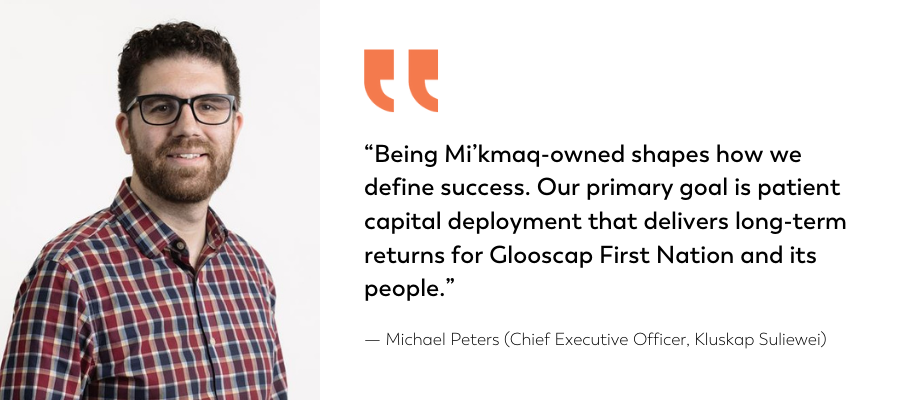
Regardless of the industry, Peters maintains a singular focus. “Being Mi’kmaq-owned shapes how we define success,” he says. “Our primary goal is patient capital deployment that delivers long-term returns for Glooscap First Nation and its people.”
That long-term view extends to workforce development. “We view requirements as a chance to invest in people, build disciplined teams, and be rigorous about training and upskilling our workforce so our employees can grow and advance in their careers with us,” says Peters.
As defence and infrastructure spending increases, Peters emphasizes the importance of lasting impact. “Increased defence and security spending is creating opportunity, but it does not change our mandate,” he says. “Our focus has always been on building Nation-owned businesses that can lead in these sectors.”
Preparation, he says, has been intentional. “We invested in capacity building ahead of demand,” says Peters. “When public investment increases, it allows that capacity to be deployed at greater scale.”
For communities, the benefits compound over time. “As a Nation-owned organization, the returns generated through this work are reinvested back into the community to support workforce development, economic diversification, and opportunities for the next generation,” says Peters. “The real benefit comes when the people and businesses built through one project are still here and able to take on projects over and over again,” he says.
Digital capability as a force multiplier
Technology is increasingly central to defence operations, and REDspace’s defence practice draws directly from its experience in digital media and training. “Core business in digital media and entertainment business for more than 25 years has created many dual-use technologies,” says Ken Howard, Defence Practice Lead at REDspace.
That experience supports defence clients as systems modernize. “REDspace helps defence customers interpret, introduce, and deliver to operations leading digital solutions,” says Howard. “UX and UI are key elements of a digital platform that leads the Canadian Armed Forces to its stated goal of digital literacy across its workforce.”
Data systems are a critical part of that shift. “Data drives legacy software and hardware solutions,” says Howard. “REDspace’s approach unlocks data that is often trapped in silos and makes better decisions faster.”
Security remains foundational for Howard. “All REDspace solutions observe industry best practices and defined security standards necessary to operate in defence programs,” he says. “Lessons learned from protecting high value digital properties across a global distribution with millions of concurrent users have provided us with the necessary pedigree to protect Canada’s digital interests.”
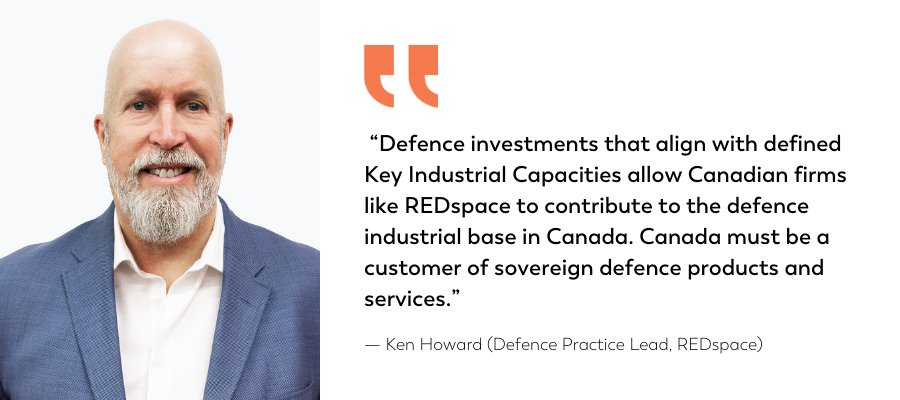
Stronger domestic investment supports that work. “Defence investments that align with defined Key Industrial Capacities allow Canadian firms like REDspace to contribute to the defence industrial base in Canada,” says Howard. “Canada must be a customer of sovereign defence products and services.”
For organizations in the defence sector, the months ahead will determine how effectively investment is translated into sustained economic growth. For Nova Scotia’s business community, the work is already underway.