How Halifax’s not-for-profits are strengthening the foundations of community and economy
In Halifax and beyond, three basic needs significantly impact the wellbeing of both community and economy: food security, healthcare, and housing. Behind each of these basic needs are dozens of not-for-profit organizations working to make access equitable and sustainable in Halifax. Together, these organizations support the systems that allow people to live, work, and contribute to our region’s vibrancy and economic strength.
Shared responsibility
At the QEII Foundation, the idea of shared responsibility is central to how health care innovation happens. “The QEII Foundation works closely with QEII Health Sciences Centre leaders and Nova Scotia Health, who identify the areas of greatest need,” says President and CEO Susan Mullin. “By working together, they set and approve the priorities for innovation or new technology based on the needs within the system, and we are then able to work with donors on aligning their area of interest and the impact they want to make for patients and families.”
Those collaborations fuel projects that reach beyond the walls of the hospital, shaping the workforce and the province’s capacity for innovation. “Healthcare is a common thread that unites us all,” says Mullin. “Whether we directly experience our own healthcare challenges or are there supporting our loved ones, when all else is stripped away, health matters most.”

Partnership and possibility
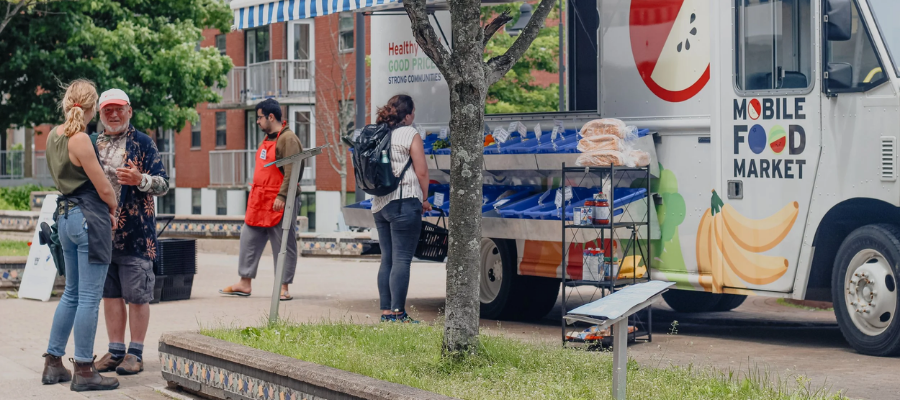
For Mandy Chapman, Executive Director of the Mobile Food Market, the lesson of scaling up food access programs across HRM is rooted in relationships. “The biggest lesson we’ve learned in scaling the Mobile Food Market across HRM is that community relationships and investment are everything,” she says. “Communities that contribute both time and financial support are critical to sustaining our services and partnerships.”
Through weekly markets and delivery programs, the Mobile Food Market brings affordable produce to neighbourhoods across Halifax where access to fresh food is limited and where food insecurity tends to be higher. “Our partnerships with over 30 local organizations are essential to the Mobile Food Market’s success,” says Chapman. “MFM serves as the product that makes other food programs possible—providing nonprofits with limited budgets affordable access to fresh produce.”
That structure addresses hunger while also strengthening community networks and the local food economy. “Together, we transform markets from simple food distribution points into vibrant community hubs where people feel supported, connected, and empowered,” says Chapman.
Angela Bishop, Executive Director of the Housing Trust of Nova Scotia, describes a similar dynamic when it comes to housing. Her organization’s model of mixed-income housing targeting low and moderate working households relies on partnerships with governments and private organizations to build long-term affordability and stability.
“Without partners, we could not do what we are doing,” says Bishop. “Partnerships position the community housing sector to transition units from the private sector to the community sector where their affordability is protected. Governments can help accelerate the growth of the community housing sector that, with the implementation of the mixed-income model, can steward a sustainable asset well into the future for the benefit of community.”
Building sustainable systems
Whether it’s food access, healthcare innovation, or affordable housing, these organizations share a commitment to economic, social, and environmental sustainability.
For the Housing Trust, revitalizing older buildings is both an economic and environmental choice. “New multifamily rental housing can’t be offered at rental ranges within reach of low- and moderate-income households,” says Bishop. “It just costs too much to build new, including the cost of land. Existing buildings, on the other hand, can offer lower rents as a function of a building’s age and condition and as a result, cost far less per unit to acquire.”
That approach helps maintain affordable housing while preserving community fabric and reducing carbon impact. “The challenges are real—aging buildings come with surprises, from outdated systems to accessibility issues,” says Bishop. “But the benefits far outweigh the difficulties: we’re able to stabilize communities, keep residents in place, and upgrade buildings to modern standards without displacing people.”
The Mobile Food Market’s sustainability means affordability through local sourcing. “Affordability comes from the strong partnerships we hold with our suppliers, who believe in the work we’re doing and provide fair pricing,” says Chapman. “With additional support from grants and provincial and city investments, we can lower prices even further.”
Chapman adds that access and dignity are at the core of their model. “We never ask for information on household numbers or income,” she says. “You shop like you would shop anywhere else. We believe everyone has the right to fresh, good food at affordable prices.”
At the QEII Foundation, sustainability means long-term investment in the health system. Mullin says the Foundation’s We Are campaign—aiming to raise $100 million—reflects both ambition and accountability. “One of our organizational values is embracing boldness,” she says. “We push for the bold approach, while balancing our humble Nova Scotian nature by challenging the status quo and making a brave commitment to always ask ‘what if’.’”

Local impact, shared outcomes
Each of these organizations sees their work not as isolated service delivery but as part of a larger system that supports the region’s economic health. “The model is good for local business,” says Bishop. “Employers across Nova Scotia are struggling to attract and keep staff—particularly in healthcare, retail, and hospitality—because workers can’t find housing they can afford near their jobs. Our developments directly address that gap—every new HTNS unit represents a worker who can stay in their job, contribute to their community, and build a life here.”
For the Mobile Food Market, it’s about supporting the people behind those same businesses. “We call this access—a place in communities for communities where people can buy fresh, healthy food at lower, affordable prices,” says Chapman. “This allows people to pay something for their food without having to choose between food and rent, or between quantity and nutrition.”
In healthcare, Mullin sees donors and organizations across sectors coming together to ensure that care keeps pace with need. “It takes true partnership to move the needle,” she says. “We work with healthcare leaders, researchers, and Nova Scotia Health to identify opportunities and transformative solutions and show the community the role they can play in solving complex healthcare challenges. There is always room at our table for new partnerships and ideas on how to improve our hospital-based care.”
Stronger together
As Halifax continues to grow, collaboration among not-for-profits, businesses, and governments will remain essential to addressing the interconnected challenges of hunger, health, and housing. “The community housing sector has a vital role to play,” says Bishop. “There is a strong negative correlation between the percentage of community housing in a jurisdiction and the extent of homelessness.”
For Chapman, that same principle applies to food access: small, local efforts can build widespread resilience. “With the right support, we can maintain and scale up something that we know works, reaching more communities and creating sustainable access to healthy food,” she says.
Mullin sums it up simply. “We encourage everyone to join us,” she says. “Let’s make a big impact, together.”